Every new company seems to be “AI-native” now.
The pitch is familiar. The team is smaller. The work is faster. The software does what once took five people. An agency can produce a month of campaign ideas in an afternoon. A founder can launch with three employees instead of thirty.
Much of this is real. AI has made useful work dramatically cheaper and faster. But underneath the excitement is a question few companies can answer:
How much does one piece of finished, approved work actually cost us?
Not the cost of asking AI a question. Not the monthly software bill. The cost of something a customer is willing to pay for, after the weak ideas, factual errors, rewrites and human checking.
That distinction could decide which “AI-native” companies become durable businesses and which discover that their margins were temporary.
The visible price is not the economic cost
The subsidy that matters is often sitting inside the products companies already buy.
A flat AI subscription gives a light user and a heavy user the same monthly price, even though their cost to serve can be radically different. Light users, enterprise contracts, investor capital and profitable usage elsewhere can all help absorb the heavy user. That is normal subscription economics. The danger begins when a business treats the subsidised price available to it as the permanent cost of production.
SemiAnalysis tested this directly. The research firm bought each OpenAI and Anthropic subscription tier, ran long coding and agent tasks until the weekly limits were exhausted, and compared the allowance with standard API pricing. Its most widely reported estimates put the maximum API-equivalent value of a $200 ChatGPT Pro plan at about $14,000 a month and a $200 Claude Max plan at about $8,000 (TechSpot summary).
Those figures need an important caveat. They are not claims that OpenAI literally spends $14,000 serving a $200 subscriber. API prices include margin, and the providers’ true compute costs are not public. SemiAnalysis modelled subscription margins by assuming a 75% gross margin on the equivalent API usage. The exact loss is therefore an estimate, not an audited fact.
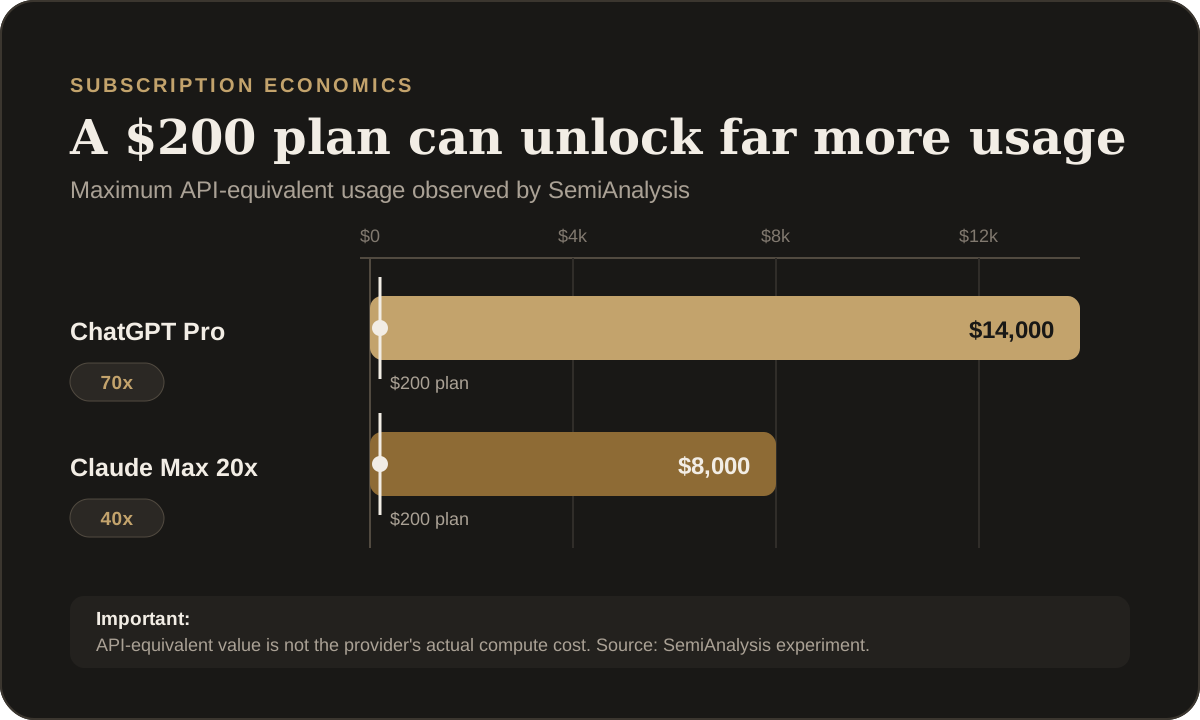
Maximum API-equivalent usage observed in the SemiAnalysis subscription experiment. This compares with public API prices and does not represent the providers’ actual compute costs.
But the gap still tells us something useful. The subscription price is not a reliable measure of the economic value being consumed. Heavy users can receive far more model usage than their fee would buy through the API, while lighter users and other parts of the business help make the plan work.
Cursor’s own research shows why that gap can grow rather than disappear. In a study with a University of Chicago Booth professor covering developers at 500 companies using Cursor, average weekly AI usage rose 44% as models improved. High-complexity work rose 68%, and media and advertising recorded a 54% increase in messages per user. Better and cheaper AI did not simply reduce the bill. It encouraged people to use more AI for more ambitious work.
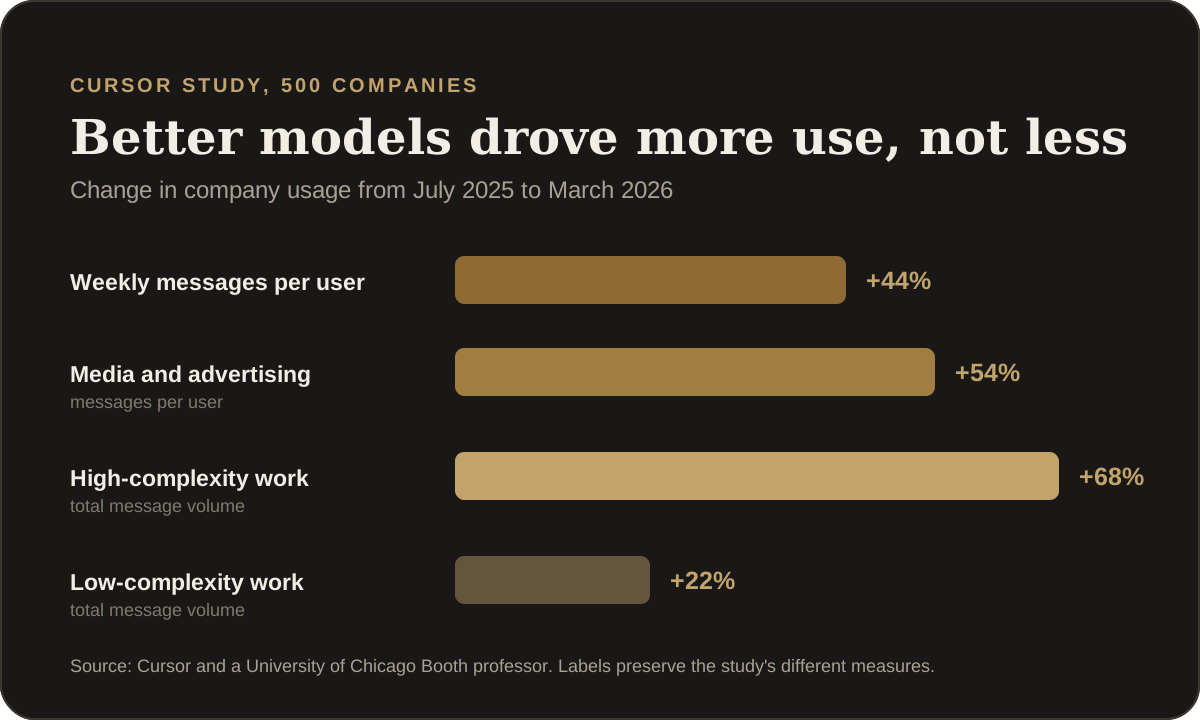
AI usage increased as models improved. Source: Cursor’s study of 500 companies, conducted with a University of Chicago Booth professor.
Cursor has also moved the measurement in the right direction. CursorBench reports average cost per task by applying each model’s published prices to the tokens used to complete benchmark tasks. That is much closer to the number a company needs than a cheap-looking monthly subscription.
The commercial pressure is already visible. When Cursor explained its own pricing changes, it said its hardest requests could cost an order of magnitude more than simple ones and moved frontier-model allowances towards API-based usage. Cursor is not proof that every AI provider loses money on every request. It is evidence that products built on external models eventually have to connect customer usage with the cost underneath it.
There is also enormous capital below the subscription price. Microsoft described its OpenAI partnership as a multiyear, multibillion-dollar investment in the computing power behind these tools. The company using an AI product does not own that infrastructure, control its price or decide how long its provider will keep absorbing the gap.
Cheap AI is real, but today’s price is not a promise
The cost of AI has fallen at an astonishing speed. Stanford’s 2025 AI Index estimated that the cost of getting performance similar to GPT-3.5 fell more than 280-fold between November 2022 and October 2024.
That decline is one of the great business opportunities of this decade. It has allowed small companies to attempt things that recently required large teams and serious capital.
But “AI is getting cheaper” does not mean every company can assume that the exact service it needs will always become cheaper.
The advertised price often depends on how quickly an answer is needed, how much information is supplied, which model is used and whether the request can be processed later. The pricing pages from Google, Anthropic, Amazon and OpenAI contain different prices for different types of use.
Models and products also change. Google’s Vertex AI release notes include both price changes and deadlines for moving away from older models. A company may be forced to change the engine behind its product even when customers expect the experience and price to remain the same.
Founders should therefore treat today’s AI price as a supplier quote, not a permanent law of business.
Agencies face the sharpest version of this problem
Consider a marketing agency that promises a client forty campaign concepts each month for a fixed fee.
The agency uses AI and sees a tiny software bill. The account looks enormously profitable. But ten concepts are generic. Six contain claims the brand cannot make. A strategist spends half a day improving the best ideas. The client rejects the first round, so the process begins again.
What did those forty concepts cost?
The answer is not the price of the AI tool. It includes the strategist’s time, the rejected work, the checking, the client revisions and the cost of every tool used along the way.
This matters because the agency carries an awkward risk. The client expects AI to make the fee cheaper. The technology provider can change its price. But the agency has already promised the output.
If the work was priced while a flat subscription was absorbing unusually heavy model use, or while people were quietly correcting weak output, the agency has made a long-term promise based on a short-term advantage.
The danger grows as the easy work disappears. The first tasks given to AI are usually repetitive: resizing copy, summarising research, producing basic variations. They are the cheapest tasks to automate. What remains is more unusual, more political and more dependent on judgement. The average job can become harder even while the technology becomes cheaper.
For marketers, quality is part of cost. A sentence that is inexpensive to generate but expensive to approve is not cheap. An idea that damages trust is not efficient. A campaign that sounds like everybody else may be technically correct and commercially useless.
The number that matters is the cost per accepted task
Many businesses track subscriptions, software bills or the amount of AI they use. Those figures are useful, but they do not reveal whether the work creates value.
A better question is:
Cost per accepted task = everything spent producing the work ÷ the number of results actually accepted
“Everything” includes AI tools, other software, failed attempts, checking, corrections and human time. “Accepted” means the result met the standard: the client approved it, the customer used it, the lead was qualified or the case was genuinely resolved.
This idea is not limited to AI. The FinOps Foundation recommends connecting technology spending to a meaningful business result, such as cost per case resolved, rather than stopping at a technical measure such as cost per request. AWS similarly describes good cost management as achieving a lower cost per business outcome.
You do not need an expensive dashboard to begin. A spreadsheet is enough. For each important type of work, record:
- what the customer asked for;
- whether the first result was accepted;
- What AI and other tools cost;
- How much human time was needed;
- How many attempts were made, and
- What the customer paid, or what the result was worth.
After a month, calculate the average cost of an accepted result and the margin it produced. Then look at the worst jobs, not only the average ones. Those are often the clearest preview of what happens when work becomes more complex.
This measurement also stops companies from celebrating false savings. Replacing four hours of writing with ten minutes of generation sounds impressive. If the result then requires three hours of senior review, the saving is much smaller, and the expensive work has merely moved to somebody else.
Ask the uncomfortable questions before investors or clients do
Every founder and agency leader building around AI should be able to answer six questions:
- What happens to our margin if flat subscriptions become metered usage?
- What happens if the price of our main AI tool doubles?
- Which services remain profitable after we include review and rework?
- How often does a human have to rescue the result?
- Can we move to another provider without rebuilding the offer?
- Can we charge more if customers demand greater accuracy, privacy or human oversight?
These are not pessimistic questions. They are how a temporary advantage becomes a real operating model.
A useful exercise is to recalculate next year’s plan using metered model prices, twice the current AI bill and ten minutes of additional human checking per job. Then assume the easiest work has already been automated and the average request is more complicated.
If the business still has attractive margins, it may be genuinely strong. If the model collapses, the company has learned something important while there is still time to change its pricing, contracts or process.
“AI-native” should mean more than using AI
A genuinely AI-native company is not simply one that uses the most AI.
It knows where AI creates value and where it creates hidden work. It can change suppliers. It prices quality honestly. It keeps human judgement where that judgement protects the customer. Most importantly, it understands the cost of the result it sells.
There is no shame in renting technology. Most companies rent offices, software and cloud infrastructure. The mistake is confusing access with ownership, or a promotional price with a permanent advantage.
AI will continue to create remarkable businesses. The strongest will not be those with the most impressive demonstrations or the smallest visible software bill. They will be the ones who can explain, in plain numbers, how cheap intelligence becomes profitable work.
The rest may not be AI-native. They may only be temporarily AI-cheap.